A full audit in days.
striga has found more than 50 CVEs in 2026, in Apache httpd, Apache Tomcat, n8n, Ollama, Mattermost, axios and pac4j, among them CVE-2026-23918, CVE-2026-34486, CVE-2026-27577, CVE-2026-25639 and CVE-2026-1046. Two of them are listed in KEV catalogs.
Traditional audit
The audit we run for you.
Timeline
Traditional audit 2–4 weeks
Results within a week
From the day we receive the code.
Coverage
Traditional audit Sampled, time-boxed
The whole codebase
Static analysis of all of it, and dynamic testing of a running application on request.
Cost
Traditional audit €20k–€50k+
From €999
Per audit, net of tax, with model compute included. The size of your codebase sets the final price.
Send us the code and our team runs striga on it. You get the report, and we take you through it. ZDR inference.
Inside striga.
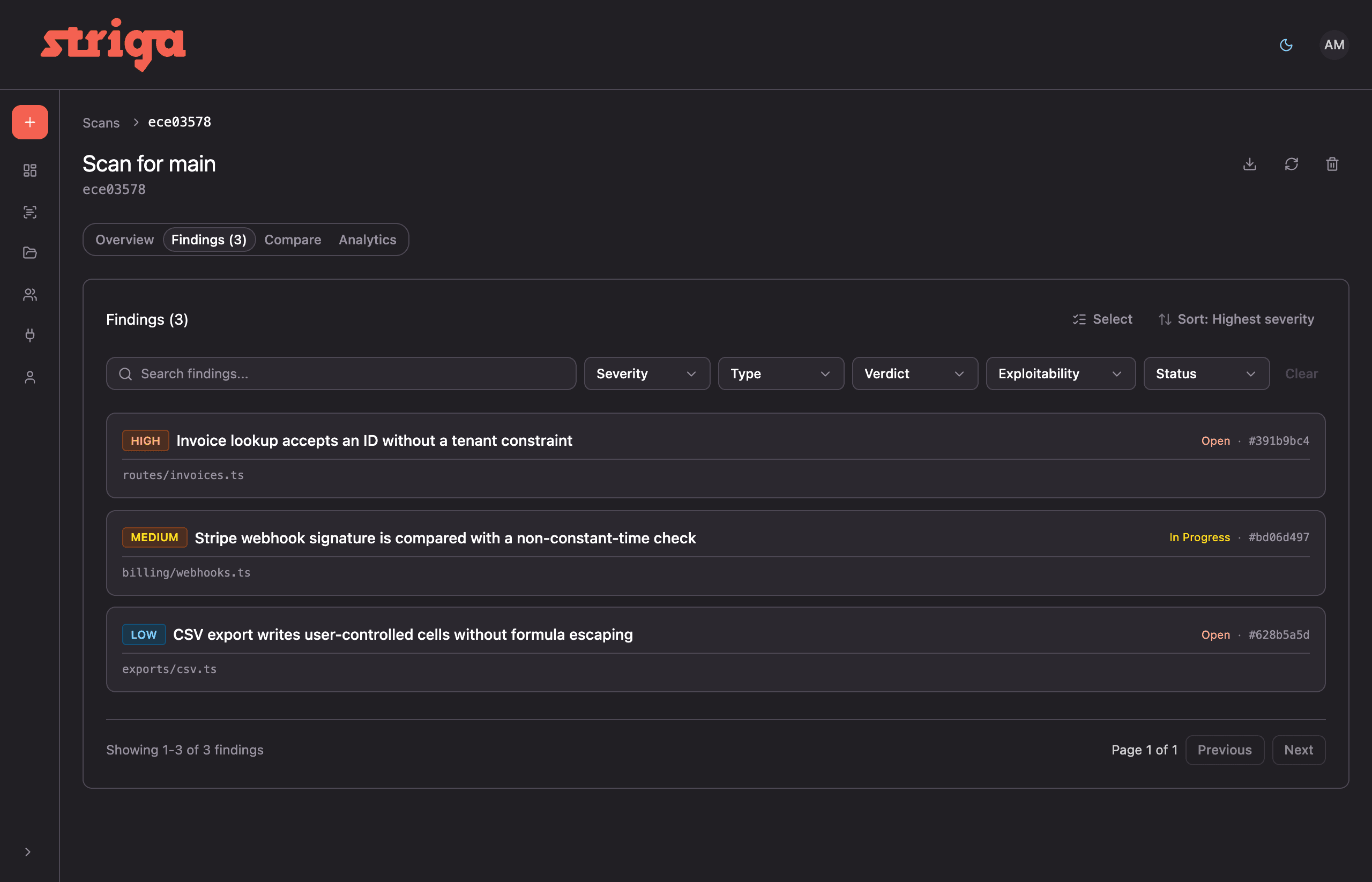
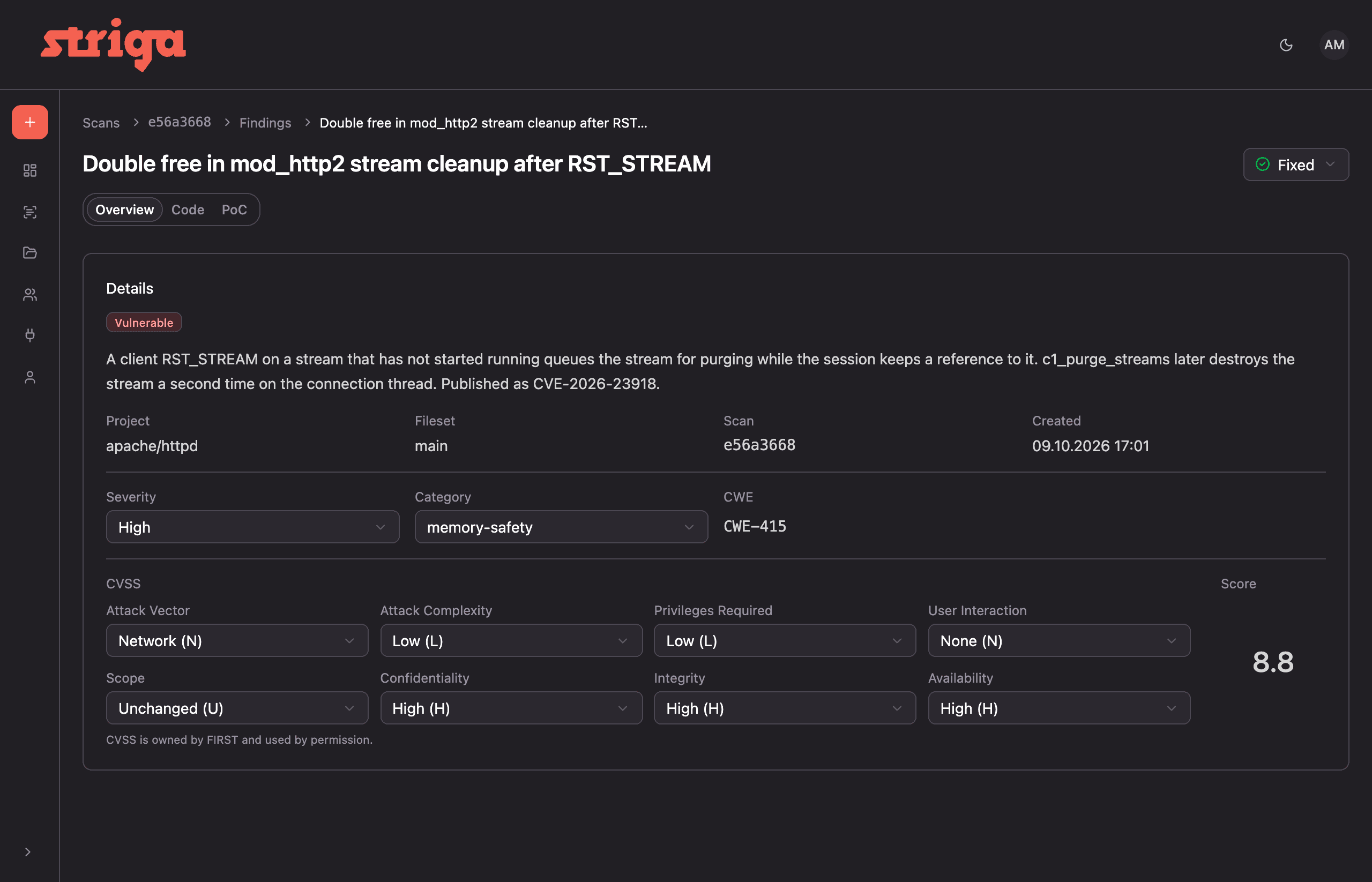
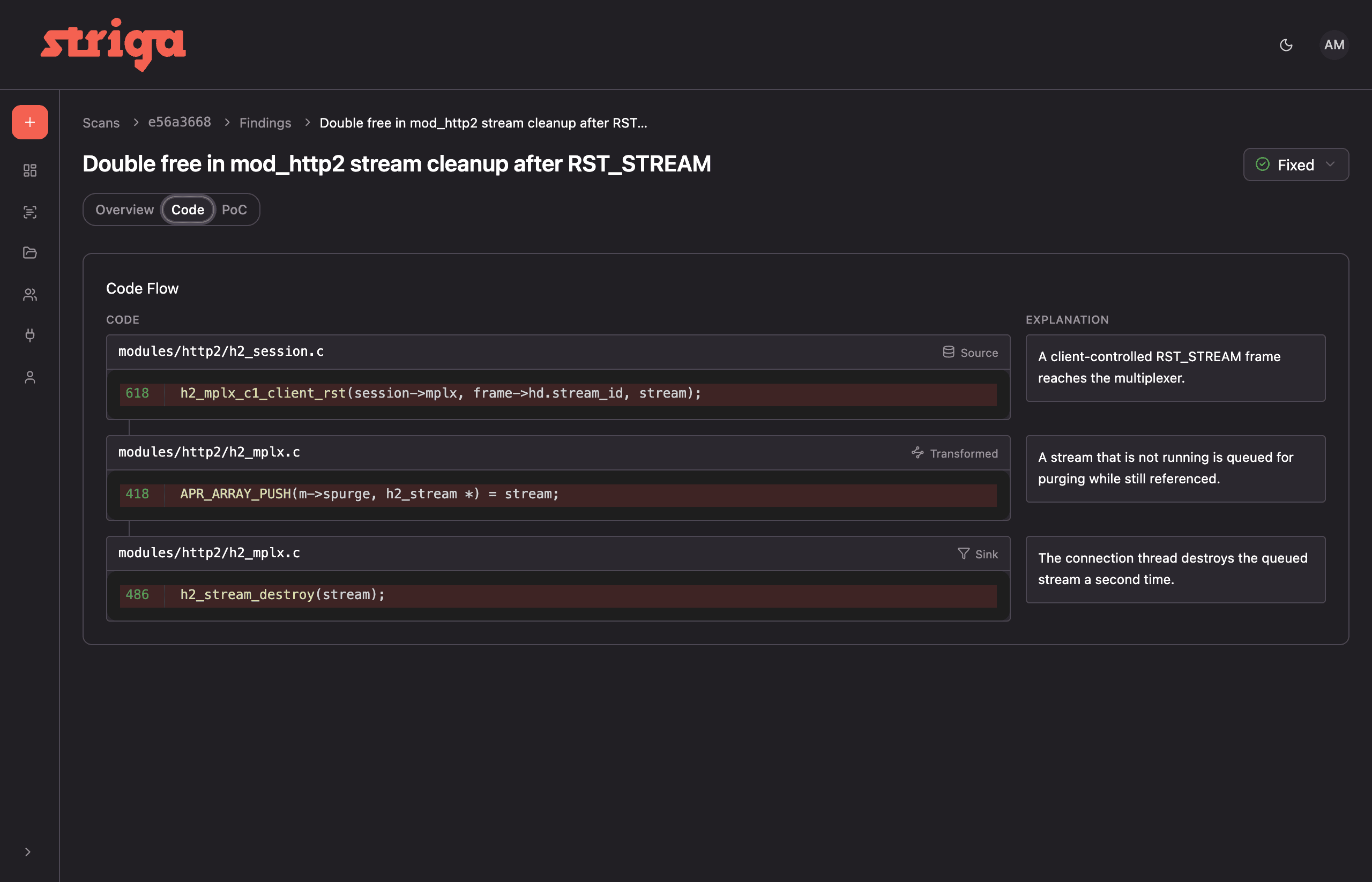
From every project you scan down to one finding and its path through the code.
See what needs attention across your projects, open findings by severity and how triage is going.
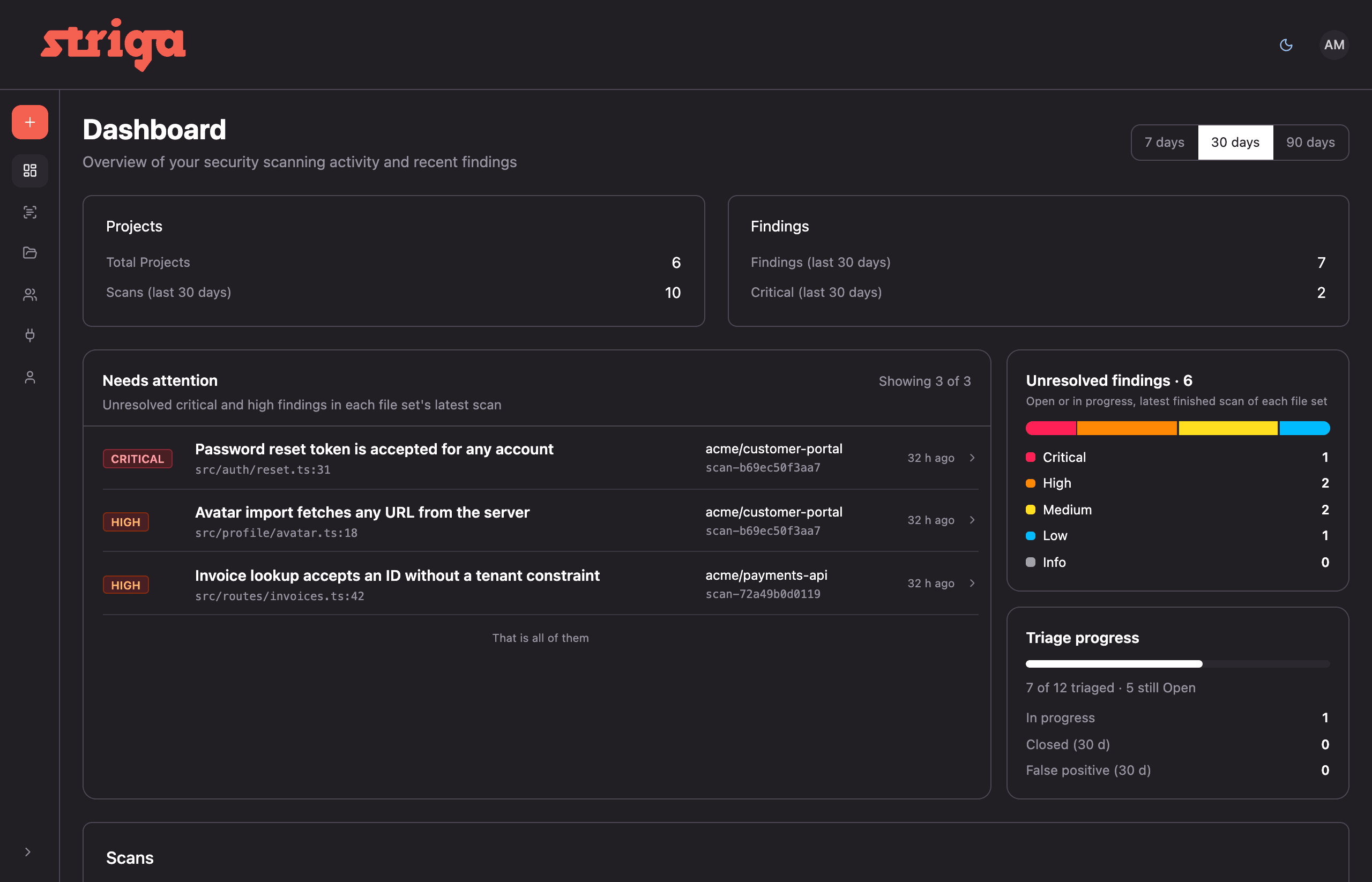
Track every project
See what needs attention across your projects, open findings by severity and how triage is going.
Use striga from your coding agent.
Every striga instance includes an MCP server. A coding agent runs an audit, reads what it found and records the triage from the session it writes code in, with a token whose scopes and expiry you set.
Any agent that speaks MCP can connect, including these.
 Claude Code
 Codex
 Hermes
 OpenCode
 Cursor
 Gemini CLI
 GitHub Copilot
 Zed
 Cline
 goose
Over 20 languages.
Java C C++ C# Python JavaScript TypeScript Go Rust Ruby PHP Kotlin Swift Scala Objective-C Bash Lua Perl
These are the main ones. Detection methods for each language are selected and kept current by security specialists.
From the people who get the reports.
Customer
Defguard is open source, so anyone can read our code, attackers included. striga reads it first: it audits every release before it ships, and our engineers act on its findings instead of debating them.”
- findings reported
- 34
- fixed
- 27
Open source maintainer
As the maintainer of two widely used open-source libraries, I see many security reports of widely varying quality. The reports I received from striga were reproducible, precisely located in the code, and rated honestly rather than inflated. Every one of them resulted in a fix or a hardening change in libheif. All of them helped to make libheif better.”
- security advisories published
- 13
- rated high
- 6
Partner
Our name is on every report we deliver, so we only bring in tools whose findings our consultants can check. striga passed that bar, and it is now part of how ISEC audits source code.”
- projects scanned
- 60+
- actionable findings
- 540
Who it’s for.
Security and engineering teams
Gate every release with an audit of the whole codebase. striga reads a codebase the way your best auditor would, and your coding agents work through its findings over MCP.
Consultancies and MSSPs
Run deeper audits of client code with striga, verify the findings and deliver reports your clients can act on.
Regulated and sovereign organisations
Finance, public sector and critical infrastructure. Keep source code on-premises and produce evidence for DORA, NIS2 and the Cyber Resilience Act.
Runs where your code is allowed to be.
striga runs on an instance we operate for you alone, or on your own servers.
On demand
Your own instance, switched on for each scan. Priced by the size of your codebase.
From €999 per scan
- ZDR inference
Dedicated instance
Your own instance, always on, run by us. With its own storage and inference capacity.
From €20,000 a year
- Unlimited scans
- ZDR inference
- BYOK
On-premises
Inside your own network, air-gapped if you need it. Source code never leaves it.
From €85,000 a year
- Unlimited scans
- ZDR inference
- BYOK
Shared cloud
Fully managed by us. Shared with other customers.
- Not available yet
Prices are net of tax.
Two ways to start.
Run striga on an instance of your own, or have us run the audit for you.